Immersive Watch Party SDK
(visionOS, RealityKit) A drop-in binary framework for synced, social video playback on Apple Vision Pro.
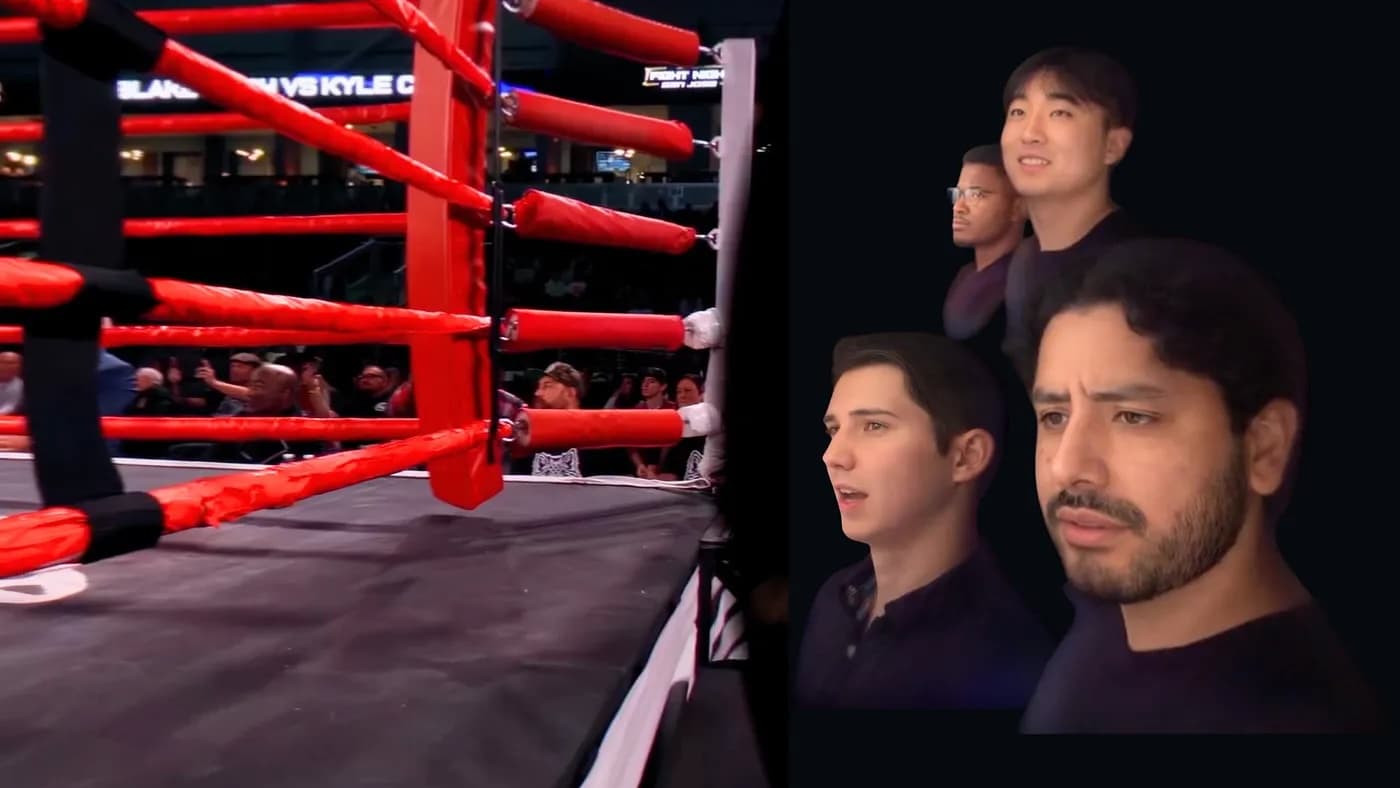
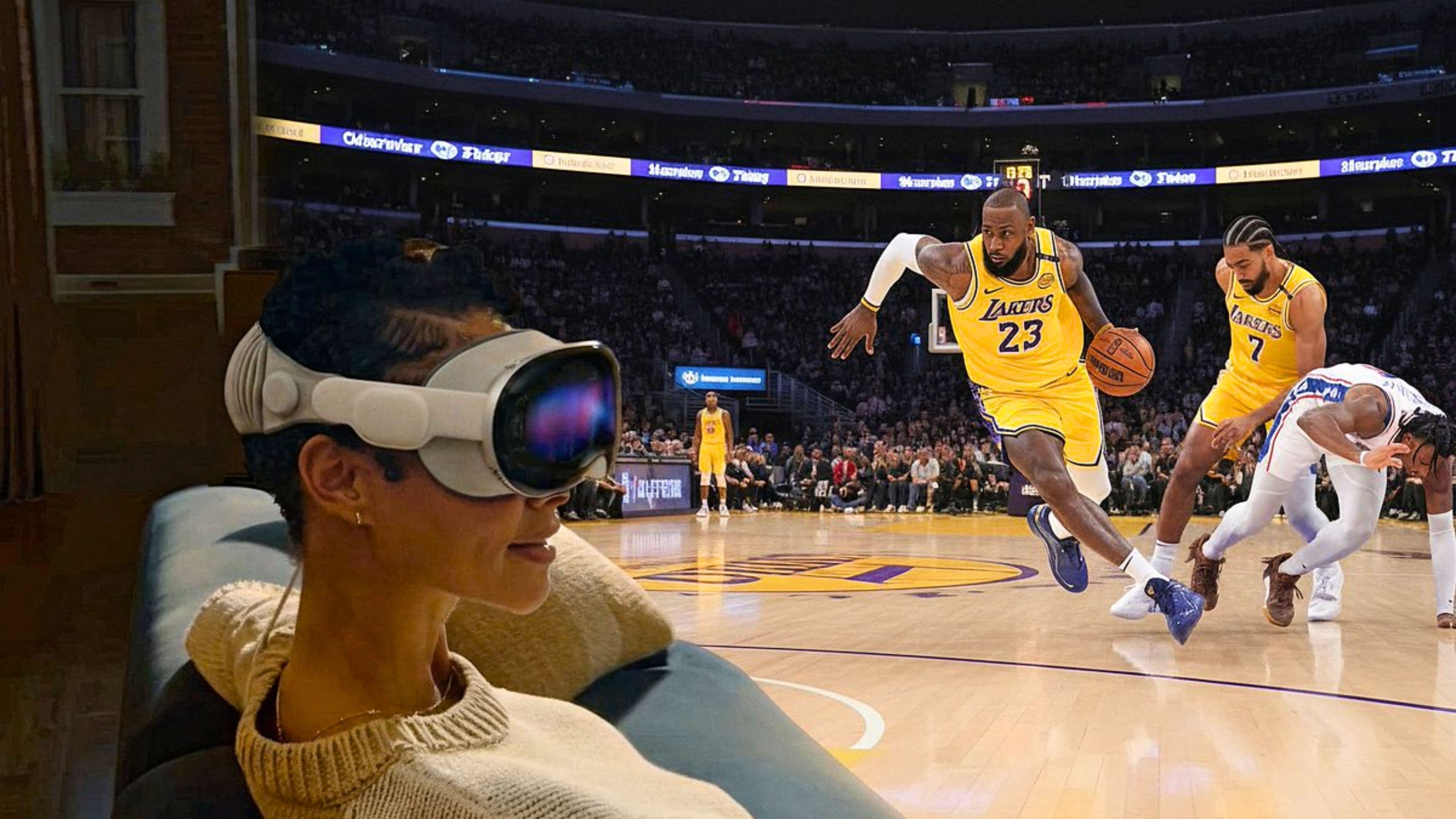
While building Vantage Sports, I ran into the core problem of the Apple Vision Pro ecosystem: VR is isolating. Watching sports is social, but making it social in VR meant building a synchronized, low-latency playback engine with spatial voice chat, which turned out to be a serious engineering project in its own right.
So I extracted that infrastructure and productized it as the Immersive Watch Party SDK: any visionOS developer can now add "FaceTime Watch Together" to their app by binding an AVPlayer and defining a few UI roles.
The Engineering Challenge
Apple's GroupActivities framework provides the bricks, not the house. I had to solve three problems:
- Frame-Perfect Sync: Coordinating
AVPlayerstates across variable network latencies. - Spatial Context: Positioning UI and avatars relative to a shared coordinate system that doesn't physically exist for all users.
- Revenue Protection: Preventing "password sharing" piracy where one paid user hosts a stream for unauthorized free users.
1. Abstracting the Math (DX Focus)
One of the hardest parts of visionOS development is managing 3D transforms (simd_float4x4). I built a declarative API (AttachmentRole) that handles the linear algebra internally.
Developers define a role (e.g., .controlPanel), and the SDK calculates the quaternion rotations and translations so the UI always faces the user at a comfortable tilt, whether they're watching solo or side-by-side with a friend.
// The SDK handles the 3D math and state management internally
// Developers just bind their AVPlayer and define UI roles

ImmersiveSpace(for: StreamModel.self) { $model in
    ImmersivePlayer(selectedStream: model)
        .coordinateSharePlay(
            partyManager: appState.sharePlayManager,
            player: videoPlayer.player,
            delegate: videoPlayer
        )
}
2. Security & Piracy Prevention
A major vulnerability in client-side SharePlay implementations is UUID spoofing. A malicious actor can inject messages claiming to be the "Host" to gain administrative control or bypass paywalls.
SharePlay messages are unauthenticated by default, so I designed a Secure Message Layer that requires server-side verification: a securityDelegate pattern where every privileged action (like "Kick User" or "Start Premium Stream") wraps its payload in a signed JWT. The SDK intercepts the message, validates the token against the backend API, and only passes the event to the client if the server returns 200 OK.
The client handshake goes from trust-based to zero-trust. If you're streaming licensed sports content, whether you're me or the NBA, you need this.
3. Concurrency & State Management
The SDK is built entirely on Swift 6 strict concurrency standards. I use @MainActor isolation for UI-bound state tracking (like active participants) while offloading heavy coordination tasks to detached Tasks.
I implemented a custom SystemCoordinatorManager that observes the GroupSession state. It handles the "Cold Start" problem where a user might accept a FaceTime invitation before the app has fully launched, queueing the activity and fulfilling it once the Immersive Space is ready.
The Product Impact
Packaging this as a reusable binary (.xcframework) paid off three ways:
- Community: The feature is now available to any visionOS app, not just mine.
- Iteration speed: New features in Vantage Sports are now decoupled from the core networking logic.
- Licensing: The SDK ships with a license-key activation flow, opening a B2B path for media companies entering spatial computing.
Try it yourself!
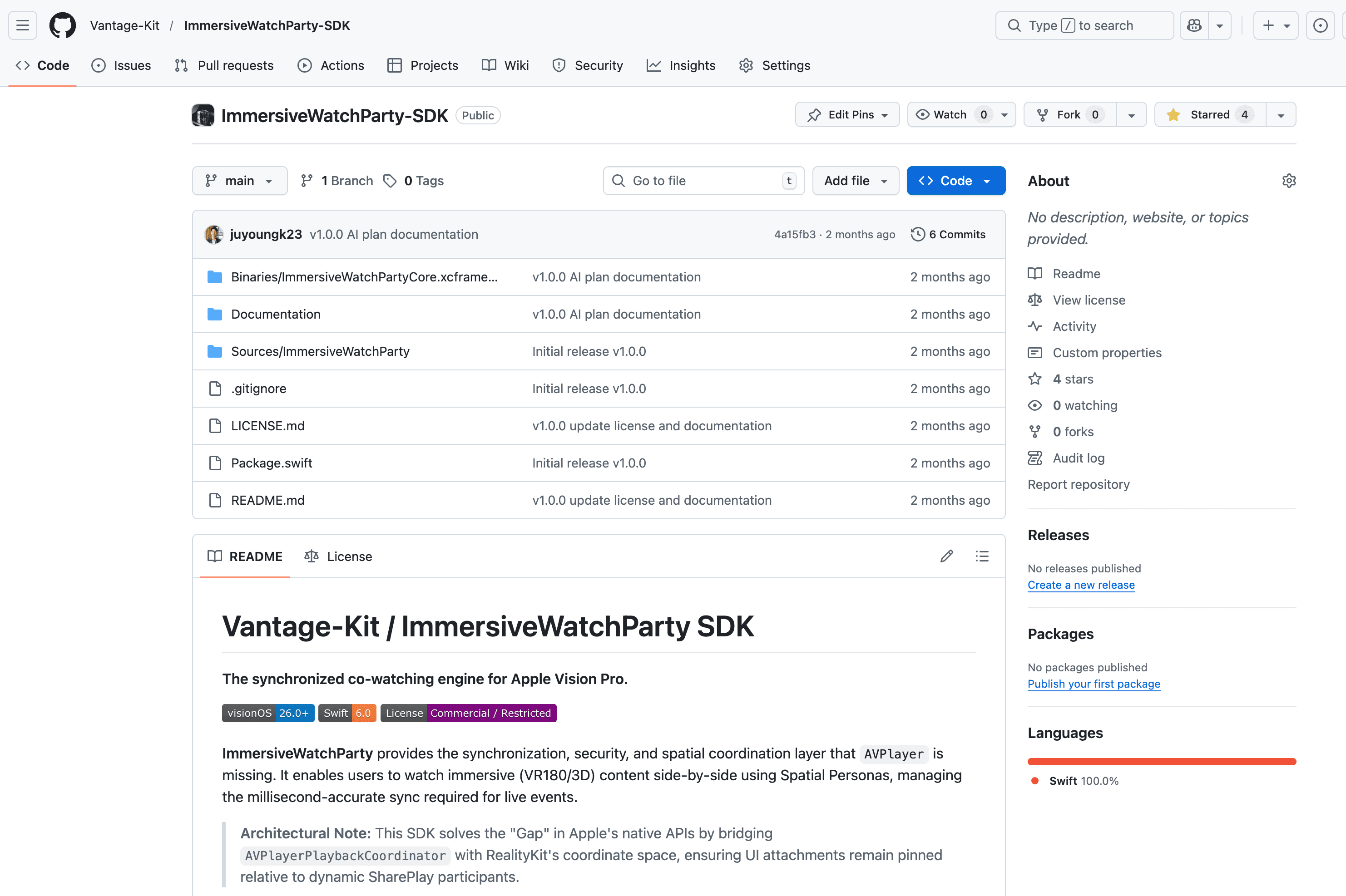
If you're building an immersive video app and want watch parties in it, check out the repo here: